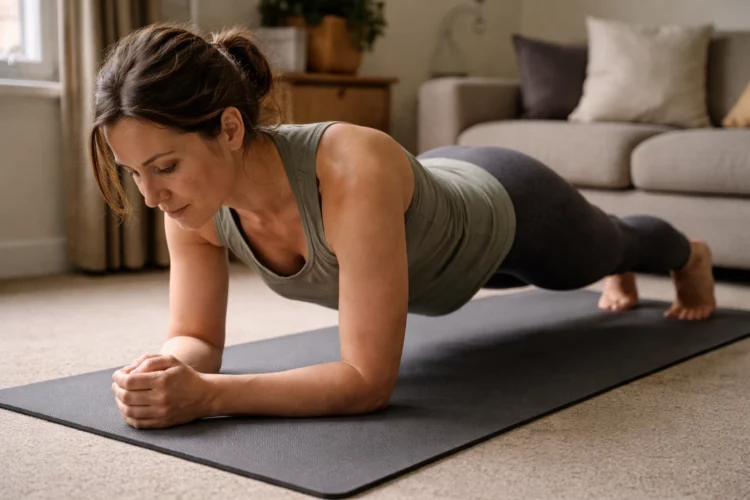
The floor feels cool beneath your forearms. Your toes press into the mat. Your breath settles into a steady rhythm. Somewhere between the quiet tension in your abdomen and the focus in your mind, the same question appears every time.
How long should I hold this?
Ten seconds feels too easy. Thirty seconds feels serious. Two minutes feels endless. Planks are often treated like a universal test, as if the same rule applies to everyone at every stage of life. In reality, a plank is a conversation between your body and gravity, and that conversation changes with age, recovery, and daily stress.
Your core remains your foundation throughout life. It stabilizes your spine, protects your back, and helps you move with control. The trick is finding the hold time that builds strength without tipping into strain or ego-driven effort.
What a plank is really training inside your body
From the outside, a plank looks almost boring. No movement. No noise. Just a straight line from head to heels.
Inside, a lot is happening.
Deep stabilizing muscles switch on together. The transverse abdominis wraps around the waist like a supportive belt. Small spinal muscles keep each vertebra steady. The diaphragm coordinates breathing with effort. The pelvic floor provides support from below. These muscles respond best to calm, precise engagement repeated consistently.
This is why quality matters more than endurance. A shaky one-minute plank with sagging hips and held breath does less for your core than a clean twenty-second hold where everything stays aligned and controlled. Time matters, but only as long as form stays intact.
Why longer is not always better
Fitness culture loves extremes. Two-minute planks. Five-minute challenges. Social media clips of bodies trembling under strain. Somewhere along the way, longer became the goal.
The reality is quieter. Past a certain point, longer planks mostly train tolerance to discomfort. The strength benefit levels off, while the risk of fatigue-related breakdown slowly rises. Hips dip. Shoulders creep up. The lower back starts to carry load it was never meant to handle.
Long planks are not automatically bad. They just stop being necessary for most people. The smarter question becomes not how long you can last, but how well you can support your body today.
This 10-Minute Yoga Flow Gently Improves Flexibility and Loosens Stiff Muscles at Any Time of Day
Plank Hold Timing by Age: How Long to Hold a Plank for Real Core Strength Without Strain
How age changes the plank equation
As years pass, the body recalculates. Recovery slows a little. Tissues become less forgiving. Balance and coordination need more attention. A plank that once felt automatic may now feel deliberate.
That is not decline. It is biology.
Instead of one rule for everyone, it helps to think in ranges that respect where your body is right now. The goal is always the same. Stop just before form begins to unravel.
Below are general guidelines for healthy adults without major injuries. They are reference points, not standards you must meet.
Teens and late teens
Ages 13 to 19 often have quick recovery and adaptable strength. Holds of 20 to 40 seconds work well, repeated two to four times, a few days per week. The focus should be on learning alignment rather than chasing time.
Your 20s and 30s
This is when many people feel physically generous. Recovery is fast. Strength builds quickly. For most, 30 to 60 seconds per hold is productive, done in multiple sets three to five days per week.
The risk here is ignoring subtle form loss. Splitting effort into shorter, high-quality holds usually beats one long, grinding attempt.
Your 40s
In your 40s, feedback gets clearer. Stiffness appears sooner. Old injuries may whisper again. Strength is still there, but it asks for attention.
Many people do best with 20 to 45 second holds, repeated two to four times, several days per week. Some days allow for longer holds. Others do not. Consistency matters more than pushing limits.
Your 50s
In your 50s, recovery often takes longer, but core training remains essential. Holds of 15 to 40 seconds, performed with focus and good alignment, are effective. Two or three sets a few times per week is plenty.
This is where listening to the body becomes a skill, not a limitation.
Your 60s and beyond
Strength does not disappear with age. It adapts.
Shorter holds of 10 to 30 seconds can be deeply effective when done well. Knee planks, incline planks on a bench or wall, and elevated surfaces are not shortcuts. They are smart choices that protect joints while maintaining core support.
How to know when your plank should end
Your body signals clearly when a plank stops being useful.
Common signs include the lower back sagging or aching, shoulders lifting toward the ears, breath holding or becoming shallow, and tension spreading into the neck or face. When these appear, the set is over.
Stopping early is not quitting. It is good training. Over time, this builds efficiency and control instead of collapse.
Making planks part of daily life
Planks do not need to be dramatic to work. They fit easily into ordinary days. One short hold before coffee. Another after work. One more before bed.
These small, repeated efforts add up. The reward is not a personal record. It is standing taller, moving with confidence, and feeling supported in everyday tasks.
Hold the plank only as long as your form feels honest. Rest. Repeat. That is how real core strength is built at any age.