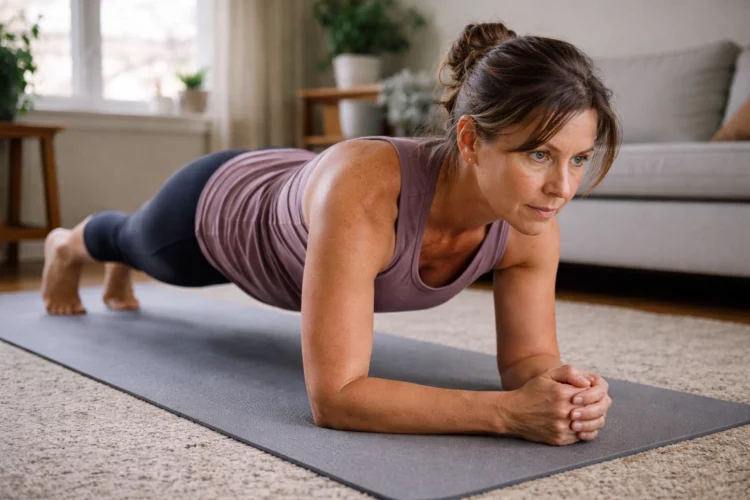
If you’ve ever tried a plank challenge, you know how quickly confidence can turn into shaking arms and a burning core. It looks simple. No movement, no equipment, just hold the position. But a proper plank is one of the most demanding full-body exercises you can do.
The question most people ask is straightforward. How long should you actually be able to hold a plank?
The honest answer is not a single number. It depends on your age, your fitness level, and most importantly, how well you maintain proper form. Still, there are realistic benchmarks that can help you understand where you stand and how to improve safely.
This 10-Minute Yoga Flow Gently Improves Flexibility and Loosens Stiff Muscles at Any Time of Day
Plank Hold Timing by Age: How Long to Hold a Plank for Real Core Strength Without Strain
Why the Plank Is Still One of the Most Effective Core Exercises
Planks are often recommended because they train your entire core at once, not just one section.
Full Core Activation in One Movement
Unlike crunches or sit-ups that mainly target the front of your abs, a plank activates multiple muscle groups at the same time. This includes:
- Rectus abdominis, the visible front abdominal muscles
- Obliques along your sides
- Transverse abdominis, the deep stabilizing layer
- Glutes, shoulders, and even your legs
This full-body engagement is what makes planks so efficient.
Real-Life Strength and Stability
A strong core is not just about appearance. It plays a key role in daily movement. From lifting groceries to maintaining posture at a desk, core stability helps protect your lower back and improve balance.
As people age, this becomes even more important. Strong core muscles are linked to better mobility and reduced risk of falls, which is a major concern in older adults across the United States.
How Long Should You Hold a Plank Based on Your Age
There is no perfect number that applies to everyone, but general ranges can give you a clear idea of what is considered average and what counts as strong performance.
Ages 18 to 39
General Fitness Level
Most people fall between 45 and 90 seconds
Above Average Fitness
60 to 120 seconds or more
This group typically has higher muscle endurance and faster recovery, which allows for longer holds when trained properly.
Ages 40 to 59
General Fitness Level
Around 30 to 75 seconds
Above Average Fitness
45 to 90 seconds
Natural changes in muscle mass and joint health begin to affect endurance, but consistent training can still maintain strong performance.
Ages 60 and Above
General Fitness Level
Around 20 to 60 seconds
Above Average Fitness
30 to 75 seconds
Even shorter holds can be highly effective in this age group, especially when done with excellent form and consistency.
Why Form Matters More Than Time
It is tempting to chase longer plank times, especially when comparing yourself to others. But duration alone does not equal strength.
A 30-second plank with perfect form is far more beneficial than a 2-minute plank with poor alignment.
What Proper Form Looks Like
- Elbows directly under shoulders
- Body in a straight line from head to heels
- Core fully engaged, not relaxed
- Glutes and legs active
- No sagging hips or arched lower back
When your form breaks down, the exercise stops being effective and can even increase the risk of strain.
Common Mistakes That Limit Your Progress
Letting the Lower Back Arch
This usually happens when the core is not properly engaged. It shifts pressure away from the abs and onto the spine.
Holding Without Tension
Some people stay in the position longer by relaxing muscles. This defeats the purpose of the exercise.
Ignoring the Upper Body
Collapsed shoulders and poor arm positioning reduce stability and can cause discomfort over time.
How to Improve Your Plank Time Safely
Start With Manageable Intervals
If you are new or rebuilding strength, begin with 15 to 20 seconds. Focus on perfect form rather than pushing duration.
Build Gradually
Increase your hold time by 5 to 10 seconds as your strength improves. Small increments lead to better long-term results.
Train Consistently
Two to three sessions per week is enough to see improvement without overloading your body.
Add Supporting Core Exercises
To build real endurance, combine planks with movements like:
- Side planks
- Bird dogs
- Dead bugs
- Loaded carries
These exercises reinforce stability and help you hold stronger planks over time.
The Truth About Long Plank Holds
Holding a plank for several minutes might look impressive, but it is not always the most effective goal. As fatigue sets in, most people lose tension and rely on passive positioning just to keep going.
Instead of chasing extreme times, focus on:
- Strong, controlled holds
- Full-body engagement
- Progressive difficulty, such as adding movement
This approach builds functional strength that actually carries over into daily life.
Where You Stand and What to Do Next
If your current plank time falls within the ranges above, you are on the right track. If it is lower, that does not mean you are behind. It simply means you have room to build strength.
The key is consistency. A few well-executed planks each week can lead to noticeable improvements in posture, stability, and overall fitness.
And in many cases, the goal is not to hold longer forever. It is to hold better.
Because when it comes to planks, quality always beats time.