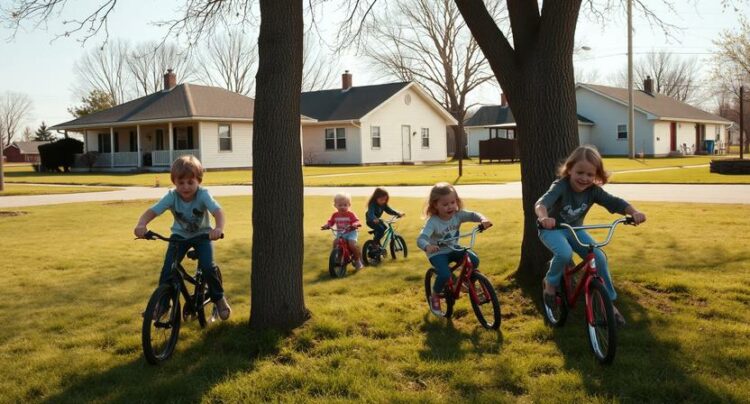
Ask someone who grew up in the 1960s or 1970s about their childhood, and a familiar picture tends to emerge. Long hours outdoors. Minimal supervision. Problems handled without immediate adult intervention. Boredom that had to be solved, not avoided.
At first glance, it can sound like nostalgia. But psychologists are increasingly pointing to something more concrete. Many adults raised in that era appear to share a set of mental strengths that are becoming less common today.
These are not personality quirks or generational myths. They are patterns tied to how people were raised, shaped by an environment that demanded independence, patience, and adaptability from an early age.
Why That Era Produced a Different Kind of Resilience
Childhood in the 1960s and 1970s was not designed around optimization. It was not curated, scheduled, or constantly supervised. It simply unfolded.
Children had fewer safety nets and fewer distractions. That meant they had to figure things out on their own, often through trial and error.
Modern psychology suggests that this combination of freedom and challenge created a powerful developmental environment. Not perfect, but highly effective at building certain mental skills.
The Seven Mental Strengths That Stand Out
Comfort With Boredom and the Ability to Create
For many children in that era, boredom was a daily experience. There were no smartphones, no endless streaming options, no instant entertainment.
Instead of avoiding boredom, they learned to work through it. They invented games, built things, explored, and used imagination as a tool.
Today, constant stimulation has largely replaced that process. Many people now feel uncomfortable when there is nothing to do, which can limit creativity and increase anxiety during unstructured time.
Independent Problem-Solving
When something went wrong, children were expected to handle it themselves, at least initially. Lost a ball, had a disagreement, got stuck somewhere. The first instinct was to solve it, not to escalate it.
This repeated exposure to small challenges built confidence. Over time, it reinforced the belief that problems could be handled without immediate help.
Today, many decisions and challenges are shared with or transferred to adults, which can delay the development of that same internal confidence.
Willingness to Take Calculated Risks
Climbing trees, riding bikes without constant supervision, exploring neighborhoods. These activities came with risk, but they also taught judgment.
Children learned the difference between what felt scary and what was actually dangerous. That distinction is critical for building confidence and reducing fear-driven decision-making later in life.
Without exposure to manageable risk, people can become more cautious, not necessarily safer.
Social Resilience Without Constant Mediation
Conflicts between kids were often handled by the kids themselves. Arguments, misunderstandings, and even fights were part of learning how to interact.
This built negotiation skills, emotional awareness, and the ability to recover from social friction.
Today, many conflicts are quickly mediated by adults or amplified through digital platforms. That can limit opportunities to develop real-world conflict resolution skills.
Patience and Delayed Gratification
Waiting used to be part of daily life. Whether it was saving allowance for something you wanted or waiting for a show to air, immediate access was rare.
That waiting period trained patience. It strengthened the ability to tolerate discomfort and work toward long-term rewards.
In contrast, modern environments often provide instant results, which can reduce tolerance for delay and increase frustration when things take time.
Physical Confidence Through Real Experience
Minor injuries were common and expected. Scrapes, falls, and bumps were part of growing up.
While not ideal, these experiences taught children what their bodies could handle. They developed awareness, coordination, and confidence through direct experience.
Today, more protective environments can reduce injury risk, but they can also limit opportunities to build that same physical confidence.
A Strong Sense of Personal Agency
Children were often responsible for their choices and their consequences. If something went wrong, the focus was on what could be learned or done differently next time.
This built what psychologists call an internal sense of control. The belief that your actions influence your outcomes.
That mindset is closely linked to resilience, motivation, and long-term mental health.
What Has Changed and Why It Matters
Parenting, technology, and culture have all shifted significantly. Many of those changes have clear benefits, including increased safety, awareness, and access to information.
At the same time, some of the conditions that naturally built resilience in earlier generations have faded.
More supervision, more structure, and more digital engagement mean fewer moments where children have to navigate challenges independently.
Psychologists are now exploring whether this shift is connected to rising levels of anxiety, lower tolerance for uncertainty, and reduced confidence in decision-making among younger adults.
Finding a Balance Between Protection and Independence
The goal is not to recreate the past. Many aspects of earlier decades came with real risks and limitations.
The more useful approach is to identify what worked and adapt it to modern life.
Create Space for Unstructured Time
Allow time without scheduled activities or digital distractions. This encourages creativity and self-direction.
Encourage Problem-Solving Before Stepping In
Give children and even adults a chance to think through challenges before offering solutions.
Normalize Safe, Manageable Risk
Activities that involve some uncertainty can help build confidence when approached thoughtfully.
Allow Discomfort Without Immediate Fixes
Waiting, failing, or feeling bored are not always problems to solve. They are often part of growth.
Why These Lessons Still Matter Today
Resilience is not something people are born with. It is built through experience, repetition, and exposure to manageable challenges.
The environment of the 1960s and 1970s happened to provide those conditions naturally. Today, they often need to be created intentionally.
The takeaway is not that one generation is stronger than another. It is that different environments produce different strengths.
And with the right awareness, many of those strengths can still be developed, no matter when or how you grew up.
Because in the end, the ability to adapt, recover, and move forward is not tied to a decade. It is shaped by the challenges you are willing to face and the independence you are allowed to build.