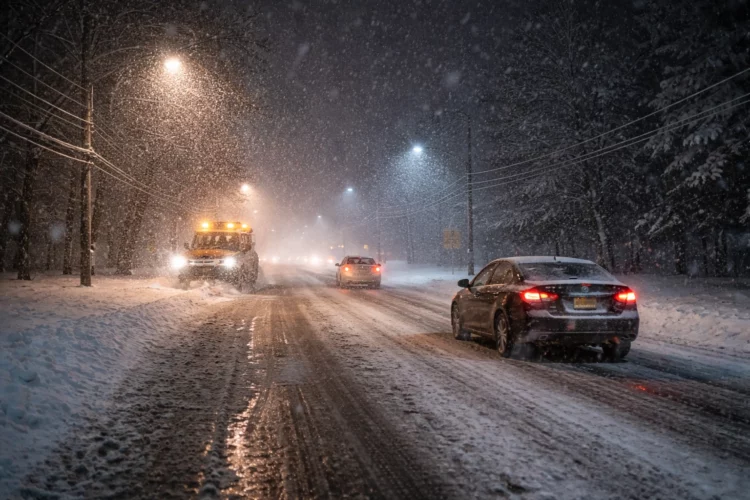
The first flakes rarely announce themselves loudly. They drift under streetlights like a rumor, barely sticking, just enough to make you pause. At a gas station off the highway, someone is loading bags of salt into a trunk while the radio repeats the same line every few minutes: heavy snow expected to begin tonight, non-essential travel discouraged.
A few feet away, a man in a neon company jacket scrolls through his phone. He looks up at the sky, then back down at a message from his boss. Business as usual tomorrow.
His shoulders sag, just a little.
Outside, a snowplow rolls past empty parking spaces, gearing up for a night where not everyone will agree on whether the city should slow down or push through.
Something always gives.
When Storm Warnings and Work Expectations Collide
By late afternoon, the tone from public officials shifts. Language hardens. Stay home. Avoid driving unless absolutely necessary. Forecast maps fill with deep blues and purples. Traffic cameras show brake lights glowing earlier than usual.
At the same time, office group chats and work emails tell a different story. Normal operations. Plan to be in. We’ll reassess in the morning. Everyone knows what that usually means. Show up unless the situation becomes impossible to ignore.
In many parts of the U.S., this clash plays out the same way every winter. Authorities measure risk in crashes, injuries, and delayed emergency response. Employers measure it in missed shifts, lost revenue, and the fear of setting a precedent they will be expected to follow again.
Between those calculations sits a single car on a dark road, tires skimming slush, trying to reach a job that may or may not justify the risk.
The People Who Feel the Storm First
Delivery drivers, overnight staff, healthcare aides, warehouse workers. They hear the warnings and feel the pressure at the same time.
One driver described being stranded overnight last winter when a storm intensified faster than expected. He slept in his van at a loading dock, knees pressed against the steering wheel, phone battery nearly dead. When he finally made it home the next day, he was told he would receive partial credit for the shift.
This year, he packed a blanket and extra food before sunset. Not because he wanted to, but because experience taught him not to trust optimism over weather.
Snow does not care who is considered essential.
Why Authorities Say Stay Home, Even When Roads Look Fine
Meteorologists and transportation officials do not issue travel warnings lightly. They are watching more than snowfall totals. They track visibility, wind gusts, road temperatures, and how quickly plows can realistically keep up.
Police departments watch spin-outs per hour and response times. Emergency managers watch hospital capacity and ambulance delays. A road that looks manageable at 7 p.m. can turn into a string of stalled vehicles by 10.
When officials urge people to stay home, they are often trying to prevent the secondary effects. Crashes that block plows. Fenders that stop traffic long enough for ice to set. Drivers who head out late, assuming it will be fine, only to discover too late that conditions have tipped.
Why Businesses Still Push Forward
From the business side, the pressure is real too. Closing early or delaying operations costs money. It disrupts schedules. It invites comparisons the next time snow is forecast. If they close now, will employees expect it again?
Some managers genuinely believe roads will be passable. Others feel trapped between higher-ups and workers. A few simply default to habit, assuming people will figure it out individually.
The result is mixed messaging. Stay home, but be at work. Be safe, but don’t miss your shift.
That contradiction is where stress spikes.
How to Make a Clear Decision Before Conditions Deteriorate
Treat Your Commute Like a Risk Assessment
Before snow begins in earnest, check the latest radar, road conditions, and traffic cameras along your route. Then ask one direct question. If you slid off the road halfway there, would this trip still feel worth it?
If the answer is uncertain, that uncertainty matters.
Decide Earlier Than You Think You Need To
Waiting until morning often means deciding in worse conditions with fewer options. If heavy snow is expected overnight, start the conversation the night before. Ask about remote work, delayed starts, or using time off.
People who speak up early often help shape the plan for everyone else.
Move Before the Worst Window, If You Must Travel
If staying home truly is not an option, timing matters. Leaving earlier can mean the difference between wet pavement and compacted snow. Once plows fall behind, conditions degrade quickly.
Separate Preparation From Panic
A simple winter kit in the car can lower anxiety and improve outcomes. Warm layers, gloves, a flashlight, a phone charger, water, and food. Lay out clothes before bed. Treat the commute like a winter outing, not a routine errand.
No one does this perfectly every storm. Doing it once ahead of a major one can change everything.
Handling Pressure From Work When Warnings Are Clear
Use Official Alerts as Your Anchor
Citing local advisories, highway warnings, or emergency guidance takes the conversation out of personal preference and places it in shared reality.
Document, Quietly and Calmly
If you are being pushed to drive despite public warnings, save messages and note times. You may never need them, but having them can make it easier to hold your ground.
Set a Personal Red Line
Before conditions worsen, decide what makes the trip a no. Whiteout conditions. Ice glaze. Official travel bans. When that line is crossed, the decision is already made.
Removing the debate reduces stress in the moment.
In the near term, a notable weather pattern shift expected by mid-February 2026 will push heavier snowfall from the Eastern U.S. toward the West.
Short-Term Forecast (Next 7 Days)
- Southern California: A weak system is expected to bring light mountain snow from Tuesday evening into early Wednesday, February 10–11.
- Great Lakes and Northeast: A fast-moving clipper system is likely to produce significant snowfall across the Great Lakes and northern New England around February 10–11.
- Southwest: Another developing storm by Friday, February 13, could bring snow to southern Colorado and northern New Mexico.
Mid-Range Forecast (February 16–20)
A major pattern shift is expected to trigger multiple rounds of strong storms across the West.
- Sierra Nevada: A high risk of heavy snowfall is forecast from Monday, February 16, through Wednesday, February 18.
- Pacific Northwest and Rockies: Widespread mountain snow is increasingly likely across Washington, Oregon, Idaho, Montana, Wyoming, Nevada, and Utah.
- Upper Midwest: As the western storm system moves east, accumulating snowfall may spread into the Upper Midwest and Great Lakes by mid-week.
- North Dakota: Long-range models suggest the potential for a significant, plow-worthy snowstorm during the week of February 16.
Long-Range Outlook (Late February through March)
- Central and Northern U.S.: Colder air and a more active storm track are expected to return, favoring snowfall from North Dakota to New England.
- Western U.S.: March is typically the snowiest month for many western mountain ranges, and current patterns point to continued gains in high-elevation snowpack.
- Southern U.S.: Additional snowfall is possible in the southern mountains and Appalachians in late February and again in mid-March.
Living Inside the Safety Versus Productivity Tension
Storms like this are not only about snow. They reveal how much risk ordinary people are expected to absorb so daily operations can continue uninterrupted.
Some workers will still go out because missing hours means missing rent. Some managers will truly lack the authority to close. Some companies will choose to pause and deal with the fallout later.
By morning, social feeds will fill with images of stuck cars, exhausted plow drivers, and jokes about what counts as non-essential. By afternoon, the snow will taper. By next week, the roads will clear.
What lingers is the question of where responsibility really sits when safety warnings and work expectations collide.
For many people, the most powerful decision happens quietly, before dawn, staring at falling snow and choosing not to turn the key. Not because it is dramatic, but because sometimes the safest move is the one no one else sees.