The moment it really hit me was on a quiet Tuesday evening. I had unfolded my aging sofa bed for the third time that week, trying to make room for a friend in a studio apartment barely larger than a parking space. The mattress sagged in the middle, the metal frame protested loudly, and once it was open, the living room stopped functioning as a room at all. It felt more like a storage locker with a blanket thrown over it.
My friend looked around and asked, not unkindly, “How do you actually live in here?”
That question hangs over millions of small apartments right now. And it is exactly the question Ikea appears to be answering with a new approach to compact living.
The Quiet Decline of the Traditional Sofa Bed
For decades, the sofa bed was the default solution for tight spaces. It promised flexibility, a couch by day and a bed by night. In reality, it delivered compromise on both fronts.
Homes in major U.S. cities have been shrinking for years. Studio apartments and one-bedrooms are doing more work than ever before. They are living rooms, bedrooms, offices, dining areas, and guest rooms all rolled into one. The old fold-out sofa bed was designed for occasional use, not for daily life in a space where every inch matters.
Many renters recognize the pattern. At first, you dutifully fold the bed away every morning. A year later, it stays open more often than not. Cushions pile up in corners. Guests end up sitting on wrinkled sheets. Eventually, the sofa bed stops being a clever solution and starts becoming the problem.
The issue is not only comfort. It is the experience. Heavy frames that scrape floors, thin mattresses stretched over metal bars, awkward folding mechanisms, and the constant need to rearrange the entire room. The furniture dictates your routine instead of supporting it.
Designers assumed people would reset their space twice a day. Real life proved otherwise.
A Different Way to Think About Small Spaces
Instead of forcing one piece of furniture to pretend it is two separate things, Ikea is shifting toward hybrid platforms that adapt more naturally to daily routines.
The new direction is less about “sleeping on a sofa” and more about zoning a room. A single piece can define where you sit, where you sleep, and where you store your things, without turning your apartment into a puzzle you have to solve every night.
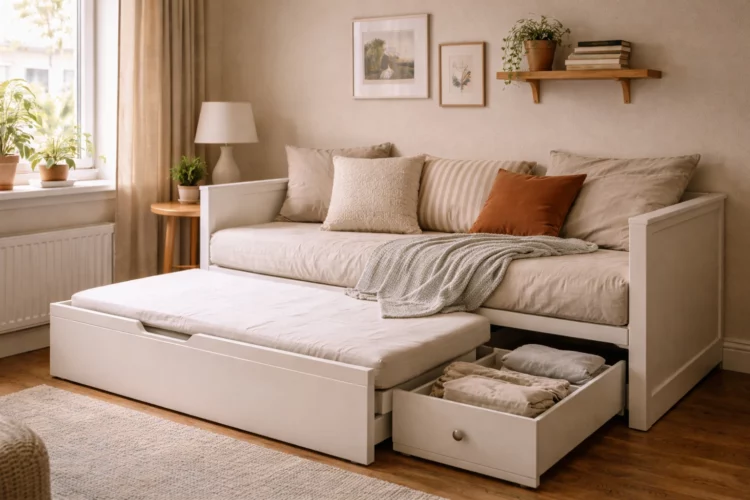
Daybeds that slide into full-size sleeping surfaces, modular seating with deep drawers underneath, and movable backrests are replacing the classic fold-out. These pieces are meant to stay in place. You extend or adjust them rather than transform the entire room.
Picture a clean-lined daybed against the wall. During the day, it works as a generous sofa with cushions and throws. At night, you pull out a second sleeping surface smoothly, without lifting heavy frames or clearing half the room. Bedding lives in drawers below, already within reach.
The result is not just convenience. The room keeps its identity. It still feels like a living space, even when it is ready for sleep.
How Thick Curtains Quietly Help Homes Stay Warmer Without Turning on the Radiators
How a Simple Shelf Above the Radiator Can Boost Heat Efficiency and Quietly Lower Your Energy Bills
Why the Classic Sofa Bed Is Losing Ground and What’s Replacing It in Small Homes
Why This Matters More in American Apartments
In the U.S., small homes are no longer a temporary stop. Rising rents, longer renting years, remote work, and frequent moves mean people are staying in compact spaces far longer than they expected.
A piece of furniture that only works well five nights a year for guests no longer makes sense. People want something that supports everyday life. Streaming a show after work. Working from a laptop during the day. Hosting a friend on the weekend without apologizing for the setup.
This shift reflects how apartments are actually used now. Living rooms double as offices. Bedrooms double as lounges. Furniture that can quietly handle all of that without demanding constant rearrangement is no longer a luxury. It is a necessity.
How to Choose the Right Alternative for Real Life
Think in Platforms, Not Categories
Stop asking whether something is a sofa or a bed. Think of it as a base that changes function with minimal effort. Stack cushions and throws during the day. Pull out the extension at night. No complicated steps.
Measure Movement, Not Just Size
Measure wall-to-wall width and test how the piece extends. Make sure you can still reach the kitchen, bathroom, or balcony when it is fully open. Clearance matters more than footprint.
Storage Is Non-Negotiable
Built-in drawers under the seat are one of the biggest advantages of these newer designs. They hide bedding, off-season clothes, and clutter that would otherwise spill into the room.
Keep Surrounding Furniture Light
Large coffee tables and bulky floor lamps can undo the benefits of a flexible bed system. Nesting tables, wall-mounted lighting, and slimmer furniture keep the room adaptable.
Design for Yourself First
Guests are occasional. Your daily routine is constant. The layout should work for you most days of the year, not just when someone sleeps over.
Living Without the Daily Furniture Shuffle
There is an emotional side to this change that often goes unnoticed. When your bed does not dominate the room all day, your home feels calmer. You stop feeling like you are camping in your own apartment. You stop apologizing to visitors for exposed bedding or awkward seating.
These newer designs do not make small homes bigger. What they do is restore a sense of control. Your space starts responding to your life instead of limiting it.
What This Shift Really Says About Modern Living
When a brand like Ikea rethinks something as familiar as the sofa bed, it signals a broader change. Small homes are no longer seen as temporary compromises. They are where real life happens.
People want furniture that can handle a movie night, a work call, and an overnight guest without turning the room upside down. The old metal-frame fold-out belongs to a time when guest beds were occasional and living spaces had clearer boundaries.
Today’s compact homes demand flexibility without chaos.
The truth is simple. Many people will live in smaller spaces longer than they once planned. Furniture that respects that reality, instead of fighting it, feels less like a product and more like a quiet upgrade to daily life.
And that may be why the classic sofa bed is finally being shown the door.