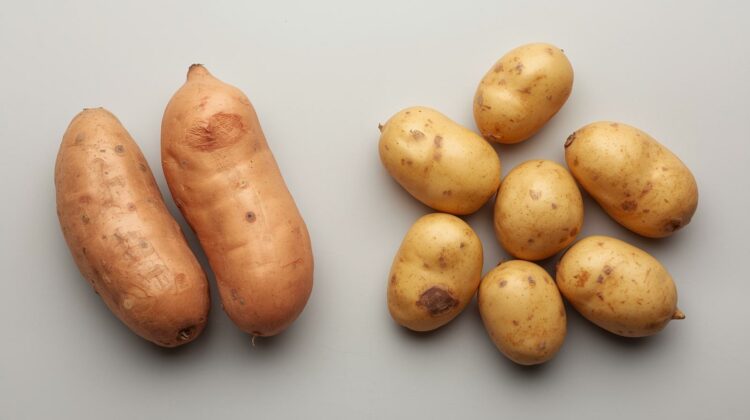
Walk through any grocery store or cafeteria and you will see them treated as near equals. Regular potatoes piled high in bins. Sweet potatoes stacked right beside them, often framed as the healthier option. Many people assume the difference is mostly about color and calories.
Science tells a very different story. Sweet potatoes and regular potatoes are barely related at all. They share a name, a rough shape, and a place on our plates, but beneath the surface they come from different plant families, evolved in different regions, and behave very differently when grown, cooked, and eaten.
Understanding that difference does more than satisfy curiosity. It changes how you cook, how you think about nutrition, and how you see food traditions around the world.
Why Sweet Potatoes and Regular Potatoes Are Often Confused
The confusion starts with language. European explorers encountered the sweet potato in the Americas and borrowed the word “batata,” which already sounded similar to the word they used for potatoes back home. Over time, the names blurred. Both became “potatoes,” even though botanically they had almost nothing in common.
They also look familiar enough to encourage shortcuts. Both are starchy, filling, and affordable. Both grow underground and can be baked, roasted, fried, or mashed. From a distance, they seem interchangeable.
That surface similarity is exactly what hides their deeper differences.
Two Completely Different Plant Families
Regular potatoes are known scientifically as Solanum tuberosum. They belong to the Solanaceae family, commonly called the nightshade family. This group includes tomatoes, peppers, eggplants, and even tobacco.
Sweet potatoes, on the other hand, are Ipomoea batatas. They come from the Convolvulaceae family, which includes morning glories, those flowering vines that climb fences and trellises.
In plant terms, that gap is enormous. These families split from each other millions of years ago. From a genetic standpoint, sweet potatoes are closer to ornamental flowers than to the potatoes most people mash with butter.
Tuber vs Root: How They Grow Underground
One of the most important differences hides beneath the soil.
A regular potato is a tuber. It is an underground stem that swells to store energy for the plant. That is why potatoes have “eyes.” Those eyes are actually buds, capable of sprouting into new stems.
A sweet potato is not a stem at all. It is a swollen root. It has no eyes and no nodes. You cannot grow a sweet potato by planting the root itself. Instead, farmers grow them from vine cuttings called slips.
This difference affects everything from how the plants reproduce to how they respond to damage and disease.
Toxins, Defenses, and Why Some Potatoes Turn Green
Regular potatoes have a built-in chemical defense system. When exposed to light or stress, they produce solanine, a bitter compound that can be toxic in high amounts. This is why green potatoes should not be eaten.
Sweet potatoes do not produce solanine. Their defenses are more physical than chemical. They toughen their skin, change texture, and redirect energy when damaged. That is why you never see a sweet potato turn green in the same way.
This difference alone shows why treating them as nutritional twins does not make sense.
What DNA Science Reveals
For decades, botanists relied on visible traits like flowers and leaves to explain the gap between these plants. Modern genetic testing removed any remaining doubt.
DNA analysis shows that sweet potatoes and regular potatoes are so distantly related that calling them close cousins is misleading. In fact, genetically speaking, a tomato is more closely related to a regular potato than a sweet potato is.
This scientific clarity explains why they behave so differently in farming, cooking, and nutrition.
Texture and Flavor: Why They Cook So Differently
Anyone who has roasted both side by side has seen this difference play out in real time.
Regular potatoes turn fluffy inside. Their starch structure traps steam, creating that soft, cloud-like texture perfect for mashing or soaking up gravy.
Sweet potatoes caramelize. As they cook, their starches convert into sugars. The edges brown, the centers turn creamy, and the flavor becomes naturally sweet.
Same oven. Same temperature. Completely different chemistry.
Nutrition: Not Better or Worse, Just Different
Sweet potatoes are often labeled as the healthy choice. That reputation comes mostly from their beta-carotene content. The orange color signals high levels of this compound, which the body converts into vitamin A.
Regular potatoes bring different strengths. They are rich in potassium and, when fresh, surprisingly high in vitamin C. They also provide resistant starch, especially when cooked and cooled.
Neither one wins by default. The nutritional value depends on your needs, your cooking method, and what you eat alongside them.
Blood Sugar and the Glycemic Question
Sweet potatoes usually have a slightly lower glycemic impact than regular potatoes, but the difference is smaller than most people think.
What matters more is preparation. Boiling, baking, roasting, cooling, and frying all change how starch behaves in the body. Deep-frying either option pushes blood sugar higher and adds significant fat.
Pairing potatoes with protein, fiber, and healthy fats has a bigger effect than choosing orange over white.
Culture and History: Two Crops, Two Stories
Regular potatoes trace their roots to the Andes, where Indigenous farmers cultivated thousands of varieties adapted to altitude and cold.
Sweet potatoes originated in tropical regions and spread rapidly because of their resilience. In parts of Africa and Asia, sweet potatoes became a critical crop for fighting hunger and drought.
These plants shaped cuisines, farming systems, and survival strategies in very different ways.
Food Security in a Changing Climate
Because they belong to different plant families, sweet potatoes and regular potatoes respond differently to pests, diseases, and weather stress.
A disease that devastates potato fields may leave sweet potato crops untouched. This diversity is not just interesting. It is essential for global food security.
As climate patterns shift, relying on a single staple becomes risky. Crop diversity is a safety net.
Choosing the Right Potato for the Right Job
Instead of asking which one is healthier, a better question is what you want it to do.
If you want something fluffy and neutral to carry sauces, regular potatoes are the better choice. If you want natural sweetness and caramelization, sweet potatoes shine.
Match the cooking method to the plant. Roast sweet potatoes slowly. Boil or mash regular potatoes confidently. This small shift changes the entire eating experience.
Common Myths That Refuse to Die
One persistent myth is that swapping sweet potatoes automatically cancels out unhealthy choices. Covering them in sugar or syrup defeats the purpose.
Another is that regular potatoes are nutritionally empty. They are not. Fries damaged their reputation, not the vegetable itself.
Understanding the difference brings nuance back into the conversation.
Language, Labels, and How Habits Form
Calling both plants “potatoes” encourages lazy assumptions. It flattens history, biology, and culture into a single word.
Once you know the difference, you start noticing more. The vines of sweet potatoes. The upright leaves of potato plants. The different smells when cut. The way each one feels after a meal.
Why This Knowledge Changes How You Eat
Awareness creates choice. You stop following food trends blindly and start cooking with intention.
Some weeks call for hearty mashed potatoes. Others lean toward roasted sweet potatoes in grain bowls or tacos. Sometimes, you just want fries and do not overthink it.
Food is not just nutrients. It is memory, culture, and comfort.
The Bottom Line
Sweet potatoes and regular potatoes are not botanical siblings. They are distant relatives that happen to share a name. That distance explains their chemistry, nutrition, farming methods, and cultural roles.
Understanding this does not force you to choose sides. It invites curiosity, variety, and better decisions.
Even practical matters like delivery delays remind us how systems shape daily life. Payment is coming payment is coming ng if you rely on the postal service.
Once you see the difference, you cannot unsee it. And that small shift changes the way you shop, cook, and eat.
Frequently Asked Questions
Are sweet potatoes and regular potatoes from the same species?
No. They belong to entirely different plant families and are only linked by name.
Which is healthier: sweet potatoes or regular potatoes?
Neither is universally healthier. Each offers different nutrients depending on preparation.
Can sweet potatoes replace regular potatoes in any recipe?
Not always. Their sweetness and texture change results significantly.
Why do some potatoes turn green but sweet potatoes do not?
Green potatoes produce solanine as a defense. Sweet potatoes use different mechanisms.
Is it better to eat the skin of potatoes and sweet potatoes?
Yes, when clean and properly cooked, the skin contains fiber and nutrients.