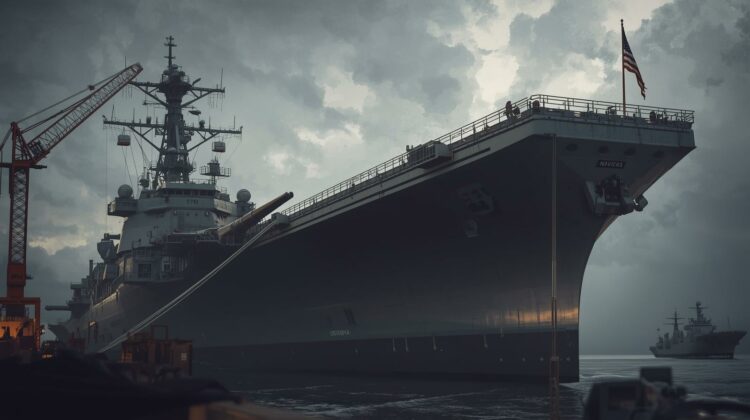
The USS Harry S. Truman easing back into Norfolk should have been a simple story. A massive aircraft carrier returns from deployment. Sailors reunite with families. Flags wave. Cameras click. For decades, this image has symbolized American sea power and reassurance that the US Navy still dominates the oceans.
But beneath the banners and ceremony, the Truman’s return carries a far more complicated message. Inside the Navy and among defense planners, it is increasingly seen not just as a success, but as a warning. A warning that the kind of ship America built its naval identity around may be sailing into a future where its strengths also make it dangerously vulnerable.
A Homecoming That Feels Familiar and Unsettling at the Same Time
On the pier, the scene looks timeless. Sailors line the rails. Children search for parents in uniform. Officers shake hands and trade tired smiles. The Truman, a floating city of steel and aircraft, looks as imposing as ever.
Yet conversations shift quickly once the cameras are gone. Quietly, officers and analysts admit that every deployment now feels different. Not because the ship is weaker, but because the world around it has changed faster than naval doctrine and procurement cycles.
The Truman returned safely. The uncomfortable question is whether a similar ship would be just as lucky in a future high-end conflict.
Why Aircraft Carriers Became the Center of American Sea Power
To understand the anxiety surrounding the Truman, it helps to understand what aircraft carriers represent. Since World War II, carriers have been the centerpiece of US naval strategy. They allow the United States to project air power anywhere in the world without relying on foreign bases.
A single carrier strike group brings fighters, electronic warfare aircraft, early warning systems, and missile defenses, all protected by cruisers, destroyers, and submarines. For decades, no rival could seriously threaten this combination.
Carriers became more than tools. They became symbols of technological dominance, industrial capacity, and global reach.
The Strategic Environment Has Shifted Dramatically
The oceans the Truman patrolled are no longer permissive spaces. Potential adversaries have spent years developing weapons specifically designed to counter US naval advantages.
China’s development of long-range anti-ship ballistic missiles, often described as “carrier killers,” is only the most visible example. These systems are designed to strike large vessels from hundreds or even thousands of miles away, forcing carriers to operate farther from shore.
At the same time, cheaper threats have multiplied. Drones, cruise missiles, and loitering munitions can now be launched in large numbers, overwhelming even advanced defenses. Conflicts in the Red Sea and Ukraine have shown how relatively inexpensive systems can impose huge costs on sophisticated militaries.
Why Size and Visibility Are Becoming Liabilities
Aircraft carriers are powerful precisely because they are large. That size allows them to launch and recover aircraft, carry massive fuel reserves, and sustain long deployments.
But size also makes them visible. Satellites, over-the-horizon radars, underwater sensors, and cyber intelligence make it increasingly difficult for a carrier to hide. Once detected, its position can be shared across networks almost instantly.
In a conflict against a peer competitor, the challenge is no longer whether a carrier can defend itself. It is whether concentrating so much capability and so many lives on a single hull makes strategic sense.
War Games and Simulations Paint a Sobering Picture
Inside classified exercises, the results are often grim. In many simulations, large carriers are damaged or destroyed early in a conflict with a technologically advanced opponent.
These scenarios do not assume incompetence or outdated tactics. They assume capable crews facing dense missile salvos, cyber disruption, and coordinated attacks from multiple domains.
While war games are not predictions, they influence planning. Repeatedly seeing carriers neutralized forces planners to ask whether tradition is outweighing realism.
How the Navy Is Trying to Adapt Without Abandoning Carriers
The US Navy is not ignoring these challenges. Instead, it is attempting to adapt the carrier’s role rather than discard it.
One major shift is the integration of unmanned systems. Aircraft like the MQ-25 Stingray are designed to refuel manned jets, extending their range and reducing risk. Future unmanned combat aircraft could strike targets without putting pilots in harm’s way.
On the surface and under the sea, the Navy is experimenting with unmanned vessels that scout, carry sensors, or even launch weapons. In this vision, the carrier becomes a command hub rather than the sole source of striking power.
The Concept of Distributed Maritime Operations
A key idea shaping naval thinking is distributed maritime operations. Instead of concentrating combat power in a few large platforms, the Navy aims to spread it across many smaller, networked systems.
This approach makes it harder for an enemy to land a decisive blow. Losing one platform does not cripple the entire force. Information, rather than mass, becomes the main advantage.
Carriers still exist in this model, but they are no longer the single hammer for every problem.
The Cultural Resistance Inside the Navy
Adapting strategy is easier than changing culture. For generations of sailors and aviators, carriers have defined naval life. They are workplaces, communities, and symbols of professional identity.
Suggesting that carriers should play a reduced role can feel like questioning the value of entire careers. Fighter pilots, deck crews, and shipbuilders all have deep ties to the big-deck model.
This emotional attachment slows change, even when logic points toward diversification.
Politics, Jobs, and the Reality of Defense Budgets
Aircraft carriers are also political objects. They support tens of thousands of jobs across shipyards, suppliers, and local economies. Cancelling or reducing carrier programs has immediate economic consequences.
Members of Congress understand this. Funding large carriers is often easier than explaining why smaller, less visible systems deserve the same investment.
As a result, strategy, economics, and symbolism become tightly entangled.
Why the Truman’s Return Sends a Mixed Signal
The safe return of the Truman reinforces a comforting narrative. The Navy deployed a powerful ship. It deterred adversaries. Everyone came home.
But it can also reinforce complacency. It risks suggesting that the future will resemble the past, even as technology and adversaries say otherwise.
For analysts, the concern is not that carriers are useless today, but that celebrating them uncritically delays harder conversations.
What Future Naval Wars Are Likely to Reward
Looking ahead, several traits appear increasingly important for naval forces.
Survivability through dispersion, rather than armor alone. Flexibility through software and networks, rather than fixed platforms. Speed of decision-making, enabled by data and automation.
Navies that adapt quickly, experiment honestly, and accept the loss of legacy systems may gain an edge over those that cling to tradition.
The Carrier’s Likely Role Going Forward
Aircraft carriers are unlikely to disappear. They still provide unmatched capabilities for peacetime presence, humanitarian missions, and limited conflicts.
In a major war, however, their role may shift toward staying farther from enemy shores, supporting unmanned operations, and serving as mobile command centers rather than front-line strike platforms.
This evolution requires accepting that carriers are tools, not icons.
Why This Debate Matters Beyond the Military
Decisions about naval strategy affect more than sailors and admirals. They shape defense spending, alliances, and the risks borne by service members.
Taxpayers ultimately fund these choices. Families live with the consequences if outdated assumptions lead to avoidable losses.
Understanding the debate helps civilians see beyond ceremonial images to the realities of modern warfare.
A Familiar Ship in an Unfamiliar Era
The USS Truman looks much the same as it did when it first entered service. Its reactors hum. Its deck crews move with practiced precision. Its aircraft launch into the sky.
What has changed is the environment it operates in. Precision weapons, surveillance networks, and unmanned systems have transformed the oceans into far more dangerous spaces.
The challenge for the US Navy is not whether it can build impressive ships. It is whether it can adapt its thinking fast enough to keep those ships relevant.
The Real Question the Truman Leaves Behind
The Truman’s return should be celebrated for what it is: a successful deployment and a safe homecoming.
But it should also prompt reflection. Are future wars likely to allow such returns? Or does this moment mark the fading comfort of a familiar model?
The answer will depend on whether the Navy treats the carrier as an evolving tool or a sacred symbol. In that choice lies the difference between adaptation and surprise.
Frequently Asked Questions
Why do some experts see the Truman’s return as a negative signal?
Because it risks reinforcing the belief that large carriers can operate near hostile shores as safely as before, despite rapidly growing missile and drone threats.
Are US aircraft carriers already obsolete?
No. They remain extremely valuable for many missions, but their survivability in a high-end war against a peer competitor is increasingly questioned.
What changes is the Navy making for future conflicts?
The Navy is investing in unmanned systems, distributed operations, new missile defenses, and using carriers more as hubs than front-line strike platforms.
Could the US stop building large carriers?
Politically and economically, that is unlikely in the near term, but debate is growing about building fewer carriers and investing more in smaller, cheaper systems.
Why should civilians care about this issue?
Because these choices affect national security, defense spending, and the risks faced by service members in any future conflict.