For years, dealing with grey hair has usually meant picking between two imperfect options. On one side, strong chemical dyes that deliver fast results but often stress the hair and scalp. On the other, natural fixes that sound appealing but rarely give consistent, believable colour.
Recently, a quieter alternative has started to circulate. It does not promise overnight transformation or permanent coverage. Instead, it relies on adding a familiar kitchen ingredient to your regular conditioner, creating a gentler way to soften grey strands over time.
This approach focuses less on erasing grey hair and more on blending it naturally.
Why many people are stepping away from traditional hair dye
Grey hair appears when pigment-producing cells inside the hair follicle slow down and eventually stop producing melanin. Age plays the biggest role, but stress, genetics, smoking, nutritional deficiencies, and some medical conditions can speed the process along. What begins as a few silver hairs often spreads gradually across the scalp.
Permanent and semi-permanent dyes remain the most common solution because they work quickly. The downside is cumulative. Strong formulas, repeated processing, and chemical reactions that open the hair cuticle can irritate sensitive scalps and weaken hair that is already becoming finer with age.
Hair without pigment tends to be drier, more fragile, and less elastic. Frequent colouring strips moisture, roughens the cuticle, and can leave grey hair looking flat rather than reflective. Even dyes marketed as gentle or ammonia-free still rely on oxidative processes that change the internal structure of the hair. What feels manageable in your twenties can feel far harsher later on.
Plant-based options like henna or indigo attract people looking for alternatives, but they bring their own challenges. Results can vary widely, tones often turn too warm or muddy, and correcting mistakes professionally is difficult once the colour sets.
The cocoa conditioner trick gaining attention
This is where unsweetened cocoa powder enters the conversation. Plain baking cocoa contains natural pigments and plant compounds that can lightly tint hair without penetrating deeply into the strand.
Rather than behaving like a dye, cocoa works more like a soft colour veil. It rests on the surface of the hair, giving grey strands a muted brown tone while allowing the hair’s natural texture and shine to remain intact. With repeated use, the effect builds gradually.
Cocoa contains flavonoids and tannin-like compounds that gently bind to the outer layer of the hair. On grey or very light hair, this creates a noticeable but subtle darkening effect. On darker shades, it enhances warmth and depth rather than changing colour dramatically.
There are additional benefits that make this method appealing. Cocoa offers antioxidant properties that help protect hair from everyday environmental stress. Its naturally softening elements can improve manageability, while mild astringent qualities may help balance scalp oil levels.
When combined with conditioner, cocoa becomes part of a treatment that nourishes and tones at the same time.
How to mix cocoa into conditioner the right way
This technique is straightforward and inexpensive, which is part of its appeal. It works best on freshly washed, towel-dried hair and can be used once or twice a week.
Preparing the mixture
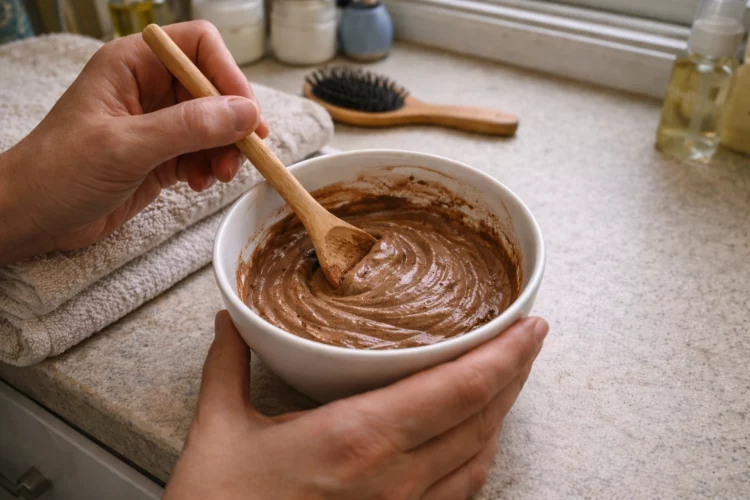
Scoop a generous amount of your usual conditioner into a clean bowl. If possible, choose a conditioner that is silicone-light or silicone-free so the cocoa can grip the hair more evenly.
Add two to four tablespoons of unsweetened cocoa powder, adjusting based on hair length and thickness. Stir slowly until the mixture becomes a smooth, thick paste with no lumps.
Applying the treatment
Section the hair and apply the mixture evenly, concentrating on areas where greys are most visible, such as the temples, part, and crown. Use a wide-tooth comb to distribute from roots to ends.
Leave the conditioner on for about twenty minutes. More resistant grey strands may benefit from up to thirty minutes.
Rinse thoroughly with lukewarm water, gently massaging the scalp to remove residue.
After the first application, many people notice that stark white strands appear softer and slightly darker, shifting toward a cool, smoky brown. With continued use, the tone deepens gradually. The aim is not dramatic coverage, but reduced contrast that makes grey regrowth blend more naturally.
Who this method tends to work best for
Cocoa-infused conditioner is most effective for people with scattered greys rather than fully white hair. It suits blondes and light brunettes particularly well, where grey strands tend to stand out more sharply.
Those with sensitive scalps often appreciate this approach because it avoids strong chemicals and harsh processing. It also appeals to anyone who prefers a low-commitment, gradual change instead of a sudden colour shift.
For very dark hair, cocoa will not fully conceal grey roots. Instead, it softens the contrast between new growth and the rest of the hair, creating a subtle tinted gloss effect rather than a solid colour.
What to expect over time
This method works through repetition, not intensity. Results vary depending on natural hair colour, porosity, and how often the treatment is used. If you stop using it, the added tone fades naturally without harsh regrowth lines.
For many people, that flexibility is part of the appeal. It offers a middle ground between frequent dyeing and fully embracing grey hair, allowing colour to be adjusted gently as preferences change.
For those looking to reduce chemical exposure while keeping their hair looking healthy and polished, this simple conditioner add-in has become an option worth exploring.