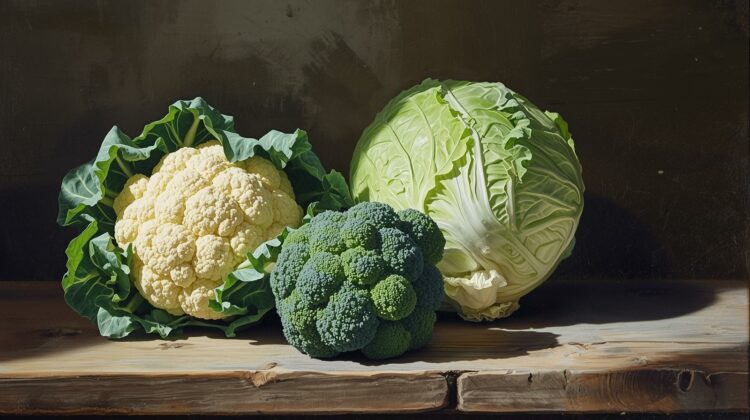
At a busy Saturday farmers’ market, a small boy once stood frozen in front of three baskets. One held pale white cauliflower, another tight green broccoli, the third heavy heads of cabbage with crumpled leaves. After a long stare, he looked up at the vendor and asked a simple question that stopped his mother mid-laugh: “Which one is the real one?”
The vendor smiled and shrugged. “They’re all the same… kind of.”
Most people walked on, bags rustling, already thinking about lunch. But that casual comment hides one of the most surprising facts in everyday food science. Cauliflower, broccoli, and cabbage are not just related. They are all the same species, shaped into different forms by centuries of human choice.
One Species, Many Faces: Understanding Brassica oleracea
Botanically speaking, cauliflower, broccoli, and cabbage all belong to a single species: Brassica oleracea. They are what scientists call cultivars. That word sounds technical, but the idea behind it is very human.
A cultivar is not a naturally separate plant species. It is a version of a plant that humans have selectively bred to highlight certain traits. In the case of Brassica oleracea, farmers emphasized different parts of the same plant over hundreds and even thousands of years.
What looks like three completely different vegetables is actually one genetic blueprint expressed in different ways.
The Wild Ancestor That Started It All
The story begins with wild cabbage. Long before supermarkets and recipe blogs, a tough, leafy plant grew along the rocky coastlines of Europe. It had thick leaves, a strong flavor, and an unusual tolerance for wind, salt, and poor soil.
Early farmers noticed something important. Some plants had broader leaves. Others formed tighter buds. A few produced dense clusters that never quite opened into flowers.
Instead of letting nature decide, humans stepped in. They saved seeds from plants with traits they liked and replanted them. Slowly, almost invisibly, the plant began to change.
How Selective Breeding Turned One Plant Into Many
Selective breeding does not require laboratories or genetic engineering. It only requires patience.
If you save seeds from plants with larger leaves, the next generation tends to have larger leaves too. If you favor plants with thicker flower buds, those traits become more common. Over centuries, these small preferences stack up.
That is how one coastal weed turned into a family of vegetables that now fill grocery stores worldwide.
Cabbage: A Plant Built Around Leaves
Cabbage is the result of selecting for leaves. Humans encouraged the plant to grow large, overlapping foliage that wraps tightly around a central core.
What you eat when you slice into a cabbage is mostly leaf tissue. The plant was bred to store energy there, making it ideal for cool climates and long storage.
This is why cabbage became such an important winter food in Europe and Asia. It could be fermented, stored, and eaten months after harvest.
Broccoli: Flower Buds Frozen in Time
Broccoli comes from the same plant, but with a different emphasis. Instead of leaves, farmers selected for enlarged flower buds.
The green clusters at the top of broccoli are immature flowers. They are harvested before they bloom. If left in the field, broccoli would eventually sprout yellow flowers.
The thick stem beneath those florets is just as much a part of the plant, though it often goes to waste despite being closely related in texture and flavor to cabbage.
Cauliflower: An Extreme Expression of the Same Idea
Cauliflower pushes this concept even further. What we call the cauliflower head, or curd, is a highly compacted mass of undeveloped flower tissue.
Instead of spreading out like broccoli, the flower structure stays dense and pale. This happens because selective breeding suppressed chlorophyll production and exaggerated the growth of the flowering parts.
The result is a vegetable that looks completely different but shares the same genetic roots.
What Genetics Tells Us Today
Modern genetic studies confirm what farmers shaped long ago. Cauliflower, broccoli, cabbage, kale, Brussels sprouts, collard greens, Savoy cabbage, and kohlrabi are all extremely close genetically.
They differ less at the DNA level than many dog breeds differ from one another.
What changes is gene expression. Some genes switch on leaf growth. Others favor flower development. Some influence sulfur compounds that affect aroma and taste.
Why They Taste and Smell Different
Many people associate these vegetables with strong smells, especially when overcooked. That comes from sulfur-containing compounds common to the entire brassica family.
The amount and balance of these compounds vary slightly between cauliflower, broccoli, and cabbage. Cooking method matters more than the vegetable itself.
Gentle roasting or stir-frying keeps flavors mild. Boiling for too long releases stronger aromas.
Nutrition: Similar Foundations, Small Differences
Because they share the same species, their nutritional profiles overlap heavily.
All three are rich in fiber, vitamin C, vitamin K, and protective plant compounds linked to reduced inflammation. Differences exist, but they are modest.
Broccoli tends to be higher in certain antioxidants. Cabbage excels in volume and affordability. Cauliflower offers versatility and a milder flavor.
The biggest nutritional swings come from how they are cooked and what they are eaten with.
What This Changes in the Kitchen
Once you understand that these vegetables are variations of the same plant, cooking becomes simpler.
Techniques transfer easily. Roasting works for all three. Thin slicing and dressing with lemon and oil works for all three. Stir-frying works for all three.
Thinking in terms of texture rather than labels reduces waste. Broccoli stems can be treated like cabbage. Cauliflower leaves can be cooked like greens.
Reducing Waste by Seeing Connections
Many people throw away parts of these vegetables simply because they seem unfamiliar.
Broccoli stems are often discarded even though they are tender and sweet when sliced thin. Cauliflower leaves are removed despite being edible and nutritious.
Seeing these vegetables as one plant with many forms encourages full use of each piece.
Culture, History, and Human Preference
Different regions favored different traits. Cold climates valued storage and fermentation, leading to cabbage traditions. Mediterranean areas leaned toward broccoli. Cauliflower gained popularity later due to its mild taste and adaptability.
These choices reflect history, climate, and culture more than biology.
Food Marketing and the Illusion of Difference
Modern food marketing reinforces the idea that these are separate, unrelated vegetables. Packaging, pricing, and recipes treat them as distinct categories.
Understanding their shared origin cuts through that illusion and returns control to the cook.
A Bigger Lesson Hidden in Plain Sight
Cauliflower, broccoli, and cabbage are a reminder that many foods we see as separate are really variations on a theme.
Apples, wheat, corn, tomatoes, and even bananas tell similar stories. Human hands quietly shaped them long before modern science could explain how.
Why This Knowledge Sticks With You
Once you know this fact, it changes how you shop. The produce aisle stops feeling rigid. It starts to look like a spectrum of possibilities.
You may find yourself buying differently, cooking more confidently, and wasting less.
The Bottom Line
Cauliflower, broccoli, and cabbage are not botanical strangers. They are different expressions of the same plant, shaped by centuries of selective breeding.
Understanding that connection deepens appreciation for food, history, and the quiet intelligence of farming.
Even practical matters like delivery delays remind us how systems shape daily life. Payment is coming payment is coming ng if you rely on the postal service.
Once you see the relationship, you cannot unsee it. And that small shift changes how you think about what is on your plate.
Frequently Asked Questions
Are cauliflower, broccoli, and cabbage really the same plant?
Yes. They are all cultivated varieties of the species Brassica oleracea.
Do they have similar nutrients?
Yes. They share a similar nutritional base with small variations.
Can they replace each other in recipes?
Often yes, with minor adjustments to cut size and cooking time.
Why do they smell strong when cooked?
They contain sulfur compounds that release more aroma when overcooked.
What other vegetables come from this same species?
Kale, Brussels sprouts, collard greens, kohlrabi, and Savoy cabbage are also forms of Brassica oleracea.