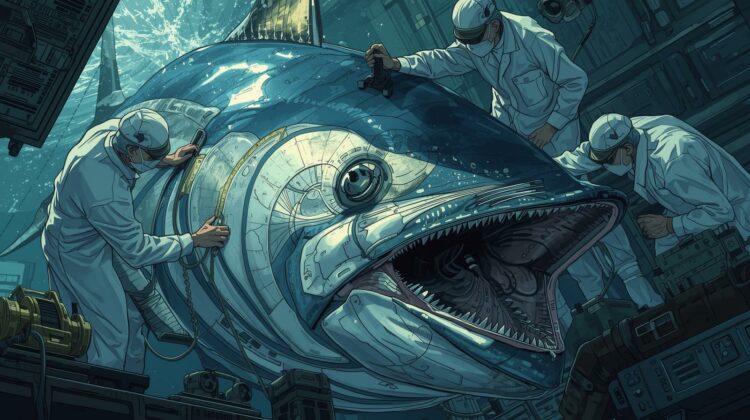
A Bluefin at Sunrise and a Dock Holding Its Breath
Just before sunrise, docks have a way of feeling suspended between two worlds. Night has not fully let go, but day is already pressing in. The air is thick with diesel fumes, salt spray, and the sour-sweet smell of old fish ground into concrete over decades. A handful of locals lean against the railings, coffee cups warming their hands, phones already out. They are waiting.
From the trawler’s deck, a shape emerges. At first it is just a shadow, then a massive body swings slowly into view, hoisted by a crane that groans under the weight. A bluefin tuna, enormous and unmistakable. Its skin flashes metallic blues and silvers even in the weak light, bruised from the fight, eyes glassy and unreadable. Someone whistles low. Someone else mutters a number, three hundred kilos, maybe more.
For a moment, the dock feels electric. This is the kind of fish older fishermen talk about with nostalgia, the kind younger ones rarely see except in photographs. Proof, perhaps, that the sea still holds giants.
Then a white van rolls in.
No one really recognises the logo on its side. A group of scientists steps out carrying clipboards, sealed coolers, telescopic measuring poles. A drone buzzes overhead, drawing a thin mechanical line across the quiet morning. They ask the fishermen to step back. A yellow tape line is drawn on the concrete. Words like protocols, calibration, and standardised measures float through the air.
The mood shifts. What was a shared moment of awe becomes something else entirely.
On the quay, people start to wonder what, exactly, is being measured anymore.
When a Fish Stops Being Just a Fish
The Shock of the Yellow Line
What surprises most onlookers is not the size of the tuna. It is the sudden formality. The fishermen who wrestled the animal from the sea are politely asked to stand aside, as if the fish were evidence in an investigation. Cameras click. Numbers are called out. Metallic rulers slide along the tuna’s flank, nose to tail.
An older fisherman shakes his head. He has spent decades reading the sea and its creatures, yet now he is not invited to comment on the weight. When he asks about the numbers, he is told they will be validated later. The phrase hangs in the air, heavy and vague.
Validated by whom? Against what?
In that moment, the bluefin stops being just a fish. It becomes a secret.
Stories from Ports Across the Mediterranean
Scenes like this have been repeating themselves in ports across Spain, France, Italy, and Croatia. A boat comes in with a massive bluefin, the kind that lights up social media within minutes. Photos spread through Facebook and WhatsApp groups. Pride swells. Then the scientific teams arrive, treating the catch like a rare specimen freshly landed from another planet.
A captain from the Gulf of Lion remembers how his tuna was first described as exceptional on the dock. Weeks later, when the official report was published, it was downgraded to within expected size range. The final weight was nearly forty kilos less than what the crew swore they saw on their boat scale.
It is in these gaps that suspicion begins to grow. How can the same fish seem to shrink once it enters the world of reports and acronyms? Why does it take months for the data to come back, neatly stamped and distant, while memories of the catch remain vivid and immediate?
In small ports, the story almost writes itself. Science is hiding something. Big fish are being downplayed. Stocks are declared under control while locals see the opposite with their own eyes. Each landing adds another layer to the divide between what is measured and what is lived.
Forget Vinegar and Baking Soda Forever: The Half-Glass Nighttime Drain Trick Plumbers Actually Trust
Inside the Strange Ballet of Tuna Measurements
More Than One Way to Measure a Giant
If you stay on the dock and watch closely, you start to see the pattern. Measuring a bluefin tuna is not a single action but a sequence, almost a ritual. First comes the length, but even that is broken into categories. Fork length from nose to tail fork. Curved length following the arc of the body. Total length with the tail stretched.
Each measurement has a code, a box on a form, a specific meaning in a database far from the quay.
Then comes the weighing. Blood is wiped from the concrete. Adjustments are made because the fish is no longer in water. Calibrated scales are checked. Water temperature and GPS coordinates are recorded. To an outsider, it can feel obsessive, almost excessive. To the people who caught the fish, it often feels unexplained.
When Time and Tension Collide
Tension flares when time becomes an issue. Buyers are waiting. The fish needs to be iced, transported, sold. Scientists ask for more samples. A sliver of muscle for contaminant analysis. A piece of fin for genetic studies. The otolith, an ear bone used to estimate age, which requires opening the head.
Suddenly the dock looks less like a market and more like a laboratory. Passers-by slow down, unsure whether they are witnessing commerce or an autopsy.
A skipper from Sicily still bristles when he tells the story of a scientist who refused to record the weight from his boat scale. Only certified equipment counted, he was told. The skipper snapped back that his scale was accurate enough to get him fined if he cheated. Why, then, was it not good enough for the report? The argument ended without resolution, just a cold handshake and a long memory.
The Logic from the Other Side
From the scientists’ perspective, the logic is clear. They need data that can be compared across ports, years, and countries. A centimetre added here, a few kilos guessed there, and the models that guide quotas and conservation measures start to drift. They work under international scrutiny, audits, pressure from governments and environmental groups.
But that logic rarely lands on the dock at six in the morning. After a twelve-hour shift at sea, no one is eager to read a two-hundred-page stock assessment report. What stays is the feeling that decisions are being made elsewhere, by people who will leave in a van once the measurements are done.
How Mistrust Quietly Takes Root
The Weight of Delays and Jargon
When data takes weeks or months to return, it creates a vacuum. In that space, rumours thrive. Locals compare the official numbers to what they remember seeing on the boat. Conversations at the bar turn into informal audits. Each discrepancy, real or perceived, becomes evidence that something is off.
Technical language does not help. Words like biomass, confidence intervals, and standard deviations sound like walls, not bridges. When fishermen are told that everything is for conservation, but cannot see how their specific catch changes anything, frustration builds.
The suspicion is rarely dramatic. It is quiet, persistent, and corrosive. Are big fish hidden to keep quotas low? Are small fish smoothed out in averages to make stocks look healthier? The questions linger, unanswered.
When Experience and Expertise Stop Talking
At the heart of the problem is a collision between two kinds of knowledge. On one side are fishermen with decades of lived experience, an internal database built from seasons, storms, and changing patterns. On the other side are researchers armed with equations, satellite tags, and statistical models capable of revealing trends invisible to the naked eye.
Both forms of knowledge are valuable. Both can be incomplete. But when they stop talking to each other, conspiracy theories slip in like damp through a cracked door.
Small Gestures That Change the Atmosphere
Sharing the Clipboard
Sometimes, rebuilding trust starts with something simple. In ports where technicians hand the clipboard to the captain and invite him to call out measurements, the mood changes almost immediately. Numbers spoken aloud feel shared, not taken away. Data becomes something observed together, not extracted.
The yellow line on the concrete starts to feel less like a barrier and more like a workspace.
Making Data Visible and Local
Some ports have taken another small but powerful step. Near the auction hall, by the coffee machine, a chalkboard lists the day’s landings. Number of bluefin. Minimum and maximum size. Average weight. Nothing fancy, nothing hidden.
It is the same information that ends up in databases, but written where everyone can see it. Familiar. Grounded. Local.
Where these practices exist, the grumbling does not disappear, but it changes tone. Instead of accusations, people ask questions. They want more detail, not less. That shift alone is a form of progress.
Explaining Why Details Matter
A marine biologist from Marseille puts it bluntly. People do not need another presentation. They need someone on the dock, coffee in hand, explaining why a two-centimetre difference in length can alter the entire story told to policymakers.
She now ends every sampling session with a short debrief on the quay. Before leaving, she posts a simple sheet at the co-op outlining what was measured that day, what will be done with the data, and when results will be available.
It does not solve everything. But it narrows the distance.
A Giant Fish as a Mirror
More Than Numbers and Quotas
In the end, a giant bluefin hanging above cracked concrete is more than a data point. It is a mirror reflecting how society handles knowledge, power, and fear. Locals see proof that the sea is not as empty as experts sometimes suggest. Scientists see a crucial data point that either fits into or disrupts carefully built models.
Between those perspectives lies a fragile space where trust can grow or collapse.
Holding Multiple Truths at Once
The uncomfortable truth is that lived experience and scientific analysis do not cancel each other out. A captain who has watched the sea change over forty years carries insights no satellite can fully replace. A young researcher may detect patterns that no human memory could ever assemble.
Often, both are partly right and partly wrong at the same time.
When they speak past each other, suspicion fills the gap. When they speak with each other, the bluefin on the crane becomes less a symbol of hidden agendas and more what it truly is: evidence that something big is happening out there, beyond the horizon.
Who Gets to Speak for the Ocean?
Next time you scroll past a photo of an enormous tuna online, it might land differently. Behind that glossy image is a quiet struggle over numbers, livelihoods, conservation, and trust. It is not always about lies or manipulation. Sometimes it is simply about distance, between those who measure and those who live with the consequences.
The giant fish leaves one question hanging in the salty air of a small port. Not what are they hiding, but who gets to hold the microphone when the ocean speaks.